
Before colonial ships ever entered the harbor, Hassel Island was home to the Taíno people—fishing, traveling, and living along the shoreline. What is now a quiet island of ruins and trails was once a peninsula known as Orkanhullet (Hurricane Hole) until 1860, when engineers separated it from St. Thomas to improve harbor circulation.
That single decision transformed the peninsula into an island and opened the door to centuries of maritime, military, and industrial innovation.
Historical records for the 1600s are limited, but the island’s waters appear throughout early exploration journals.
1607 — Captain John Smith, on his voyage to establish Jamestown, stopped here to gather wood, water, and sea turtles.
1650 — Prince Rupert’s English squadron entered the harbor; his ship struck a rock now called Prince Rupert’s Rock. Repairs were made in the protected waters of what we now call Careening Cove.
By 1672, the Danes formalized control of St. Thomas under the Danish West India Company, and the harbor quickly became a bustling haven for merchants, privateers, and pirates.
Throughout the late 17th and early 18th centuries, St. Thomas was a magnet for fortune seekers—legal and otherwise.
Hassel Island passed between ten different owners before 1784.
One of the most unsettling stories comes from 1773, when owner Jacob Magens, his wife, and their cook were murdered in their home. Their silver was stolen, and the event became enduring island lore.
During the British occupations, Hassel Island was transformed into a fortified military post.
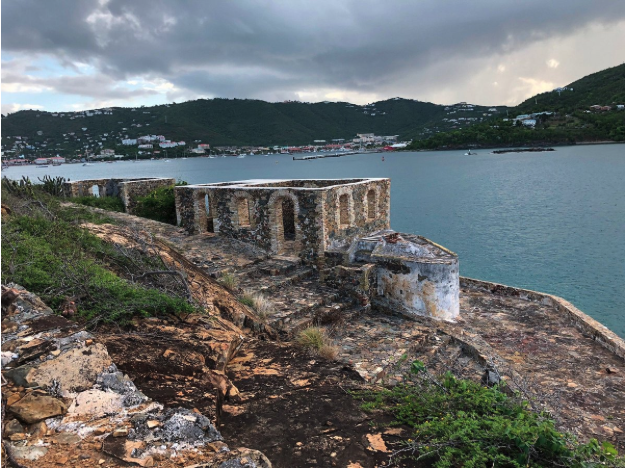
Built to defend the harbor from French and Spanish fleets, these installations once housed soldiers, armories, and lookout positions aimed directly at the sea.
Built between 1807–1815, the Garrison House was likely a Board of Ordnance stores building, constructed with thick masonry walls and reinforced shutters to protect weapons, powder, and equipment.
Today, it stands as one of the best-preserved examples of British military engineering in the Virgin Islands.
Large stone cisterns—built during the same era—collected freshwater for soldiers, guard posts, and later for coaling stations and quarantine facilities.
Their size and craftsmanship reveal how vital fresh water was to sustaining both military and maritime operations.
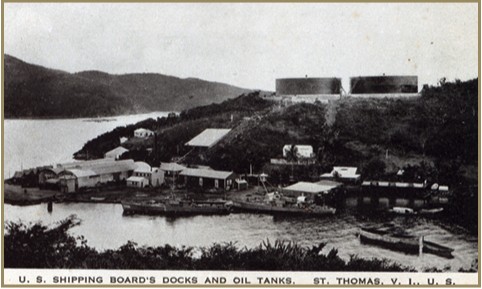
By the mid-1800s, Hassel Island became the industrial heart of St. Thomas.
One of the oldest surviving marine railways in the world, allowing ships to be hauled from the water for repair.
Its iron machinery and stone foundations still remain at Careening Cove.
A major global steamship company established a coaling and repair station here, turning Hassel Island into a critical refueling point for vessels crossing the Caribbean.
Where cannons once fired, steam engines now clanged.
Where soldiers once stood guard, coal smoke filled the air.
This shift marked the dawn of St. Thomas as one of the busiest shipping hubs in the region.
Over the years, Hassel Island served as:
a quarantine station for arriving ships
a leprosarium
a logistical hub for harbor management
a maritime repair yard
a British outpost
a Danish colonial property
Every era left its imprint on the island’s landscape.
Reality TV Meets Island History
In 2012, Hassel Island became the filming location for Season 27 of MTV’s The Real World.
The cast lived in a sprawling private estate with:
three homes totaling ~15,000 sq. ft.
panoramic harbor views
a pool built into natural rock
its own dock and helipad
Long before forts and coaling stations, Taíno navigators traveled these waters using currents, stars, and trade winds.
Long after steamships faded, coral slowly reclaimed steel.
What remains today is a rare place where:
military walls
industrial ruins
colonial stories
and natural beauty
sit quietly together.
Walking Hassel Island’s trails connects you to each of these layers—the ancient, the colonial, the industrial, the modern—held together by the sea surrounding it.
Hassel Island is more than an offshoot of St. Thomas.
It is a microcosm of the Caribbean story—Taíno heritage, European expansion, piracy, empire, industry, and even pop culture all converge here.
Every ruin is a reminder that the harbor below has always been alive with movement, ambition, danger, and new beginnings.